INTEGRATED CURRENT SENSORS
Current sensors have to be smaller, smarter, cheaper. LEM’s R&D is actively developing a range of Current Sensor IC to reduce the footprint of the current sensing function and simplify the integration of current measurement in a wide range of applications in automotive, industrial, or residential.
At low currents, shunts remain a viable solution, but they have isolation challenges and cannot provide the current sensing function alone. They require amplifiers and/or analogue-digital conversion (ADC) for signal treatment of the measured voltage drop.
Thanks to technical progress in semiconductor manufacturing and packaging, it is now possible to integrate all the stages of a current sensor in 1 single package. Current flows through the device, the induced magnetic field is sensed by two Hall-effect plates, the operation is contactless and provides inherent galvanic isolation, the voltage signal is treated inside an application-specific integrated circuit (ASIC) and this very ASIC also allows to add other ad hoc features.
As a leader in electrical measurement for 50 years, LEM is constantly developing new technologies to fit customers evolving needs. The company is now building a complete Current Sensor ICs range to serve evolving needs as well as new applications.
GO series
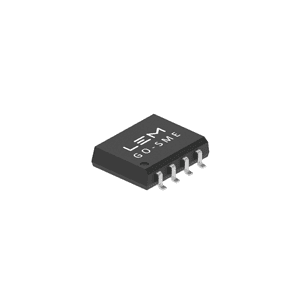
- Standard package and small footprint
- Cost effective
- A perfect compromise for small drives, robots, solar inverters, e-bikes etc.
Main features
- 1% accuracy at 25°C
- Low drifts (offset: 75uV/°C, Gain: 200ppm)
- 17mA power consumption
- Fixed and ratiometric output
HMSR series
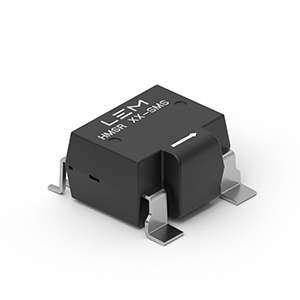
- SOIC 16 compatible footprint
- Great accuracy: Typical accuracy is 0.5% over temperature and the measurement range
- Small hysteresis of <0.5%
- Strong immunity
Main features
- Current range 6-30 Arms continuous at 125°C (75 A peak)
- Isolation: 4,950 Vrms
- Global accuracy -25°C: 0.78 %
- Global accuracy -Over T° C: 1.4 %
GXS Series
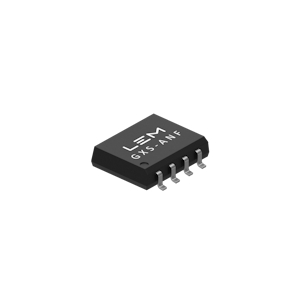
- Standard package and small footprint (SOIC 8)
- Cost effective
- High bandwidth (1MHz)
Main features
- Open loop multi-range current sensor: 5-60A
- Isolation: 3000Vrms
- Low electrical resistance: 1.2 mΩ
- Fixed and ratiometric output
GXN Series
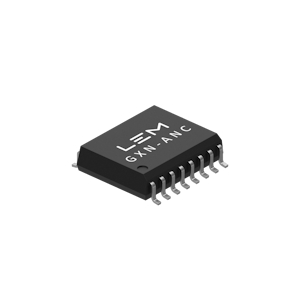
- High bandwidth (1MHz)
- High surge (13kA)
- High isolation
- Fast Over current detection
Main features
- Open loop multi-range current transducer: 10~100A
- Low electrical resistance: 0.85 mΩ
- Isolation: 5000Vrms
GXM Series
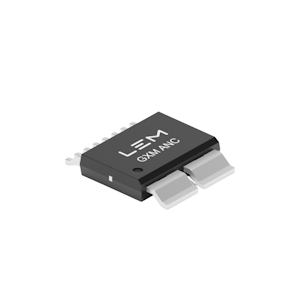
- High bandwidth (1MHz)
- Superior current and surge capabilities (20kA)
- High accuracy, low resistance
- SOIC 10L package
Main features
- Open loop multi-range current sensor: 50~200A
- Low electrical resistance: 0.27 mΩ
- Isolation: 5000Vrms
Technical Documentation
More about LEM’s Current Sensor IC
What is an Integrated Current Sensors?
Current Sensors ICs are magnetic current sensors that integrate the current conductor, the sensing elements, the signal treatment die, which includes some dedicated features such as fault detections, and the isolation, all in one single package to reduce the footprint of the current sensing function.
Why use a Current Sensor IC?
For low current, shunts remain an alternative, but they have isolation issues and require additional electronics parts to fully complete the current sensing function. Current Sensor ICs are highly integrated products that work seamlessly in every application. At LEM they are the result of leveraging 50 years of fundamental electrical knowledge, customers applications understanding and product innovation. Integrated current sensors (ICS) are the most optimized pieces of hardware to sense the current in every environment.
What is the technology used in LEM’s Current Sensor IC?
Current Sensor ICs can use Hall-effect technology or TMR technology for current sensing.
Hall-effect sensing provides a contactless way to measure the magnetic field generated by an electric current. A Hall cell is a sensing element that converts a magnetic field into a proportional electrical signal. When a constant current flows through the Hall cell, the resulting Hall voltage varies according to the magnetic field strength.
Unlike traditional Hall-effect current sensors, integrated current sensors do not use a ferrite core around the current conductor and sensing elements to concentrate the magnetic field.
Instead, Current Sensor ICs are coreless and incorporate an integrated copper conductor that carries the measured current directly through the package. Two Hall sensing elements are strategically positioned to perform a differential measurement. Both sensors detect the magnetic field generated by the measured current, but with opposite polarity, while external magnetic fields affect them in the same way. By subtracting the two sensor outputs, the influence of external magnetic fields is largely cancelled, improving measurement accuracy and immunity to interference.
5 advantages of LEM Integrated Current Sensors
Getting rid of the magnetic core offers several benefits for embedded applications:
- Reduce cost
- Increases power density on sensing side – up to 200A for LEM Current Sensor ICs products.
- Current measure is not subject to offset from magnetic hysteresis.
- Operating temperature not limited to the Curie temperature above which a ferrite can experience demagnetization (105°C), but rather by the maximum junction temperature of the device.
- Frequency and bandwidth are not limited by the inherent saturation of the magnetic element of the core.
What are the applications where Sensors IC can make the difference?
Current Sensor ICs are suitable for a wide range of applications where accurate control, efficiency and protection is needed. They allow designers to realize the current sensing function with a plug-and-play approach, with virtually all their challenges solved using only one part.
In DC/AC inverters and motors drives for example, LEM GO and HMSR can increase compactness and simplify design :
- Low power loss integrated sensors can be put closer to heat sources such as microcontroller and transistors
- Integrated isolation simplifies PCB layout
- Built-in OCD makes sure the microcontroller can put the system in safe state with minimal delay.
Exploring our Integrated Current Sensors range
Standards and certificates
| GO Series | HMSR Series |
|---|---|
| IEC 61800-5-1: 2007 | IEC 61800-5-1: 2007 |
| IEC 62109-1: 2010 | IEC 62109-1: 2010 |
| IEC 62368-1:2018 (supersedes IEC 60950-1: 2005) | IEC 60950-1: 2005 |
| UL 1577: 2014 | UL 1577: 2014 (pending) |
| UL 62368: 2019. |
Download our Current Sensor IC Whitepaper
Explore the world of integrated current sensors with our comprehensive whitepaper.
As electronics become more powerful and compact, isolated current sensors offer a solution for accurate, reliable current sensing in space-constrained applications.
This guide provides an in-depth look into the efficient and safe applications of these sensors, reflecting LEM's commitment to innovation and sustainability.