Solutions for renewable energy systems
Current sensors designed for renewable energy systems monitor and regulate the current delivered to the grid. By accurately measuring current flow and waveform characteristics, they help wind turbines, solar photovoltaic systems, and other renewable installations operate at maximum efficiency and ensure optimal energy conversion and grid integration.
Current Sensing in Renewable Energy Systems
Renewable energy systems utilize naturally replenishing sources such as sunlight, wind, water, and geothermal heat. These systems provide sustainable alternatives to traditional fossil fuels, helping to combat climate change and reduce reliance on limited resources.
LEM’s advanced sensors are specifically designed to regulate the energy flow and waveform sent to the grid, ensuring efficient operation, monitoring, and maintenance of renewable energy systems. These sensors play a critical role in enhancing system reliability, extending their lifespan, and ensuring sustainability.
In today's world, energy efficiency is a top priority, especially with the growing use of wind and solar power. Power electronics are essential for effectively managing and controlling the energy produced by renewable sources, ensuring maximum efficiency.
Renewable energy systems are becoming increasingly complex, first because they encompass a wide variety of product architectures and configurations, and second because they are increasingly designed for higher power levels. This complexity requires precise coordination between power semiconductors, system controllers, mechanical components, and feedback sensors. Current sensors provide the necessary data from the load, enabling the system to perform optimally.
Common Applications of Renewable Energy:
- Solar power
- Wind turbines
- Hydroelectric systems
- Fuel cells
- Geothermal energy
- Tidal energy
Solar current sensors and solar inverters solutions
Converting solar energy into electricity is one of the most significant advancements in modern technology. Solar energy, as a clean and renewable source, plays a vital role in reducing carbon emissions associated with traditional energy consumption. By 2050, solar power is expected to contribute up to 25% of global electricity, helping mitigate the effects of climate change.
At LEM, we are committed to advancing solar energy through high-tech sensors and solutions, ensuring solar inverters and related systems operate more efficiently, reliably, and affordably.
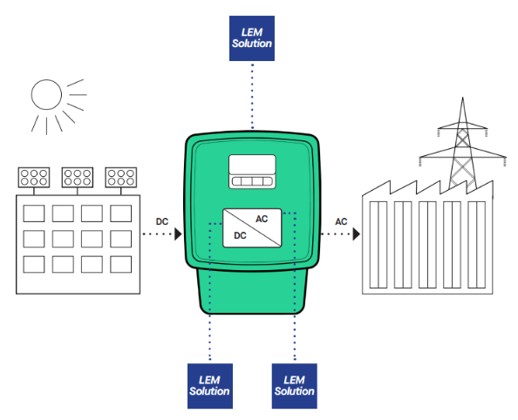
Solar inverters are essential components in converting DC power generated by renewable energy sources, like solar panels and wind turbines, into AC power that can be used in homes, businesses, or the electrical grid. Current Sensor ICs in these inverters monitor electricity flow to ensure the output current meets safety standards and system requirements.
When selecting an inverter, factors such as system size, grid connectivity, energy storage, and performance objectives play a crucial role.
Types of Solar Inverters
String Inverters vs Centralized Inverters
There are two main types of photovoltaic (PV) systems used today:
- String Inverters: Designed for small to medium power systems.
- Centralized Inverters: Used for larger, utility-scale power systems.
Micro Inverters
Micro inverters are compact devices installed directly onto individual solar panels. Unlike traditional string inverters, which connect multiple panels in series, each micro inverter converts DC electricity from its respective panel into AC electricity independently. This approach can enhance system performance by isolating the output of each panel, making it more efficient and reducing the impact of shading or panel failures.
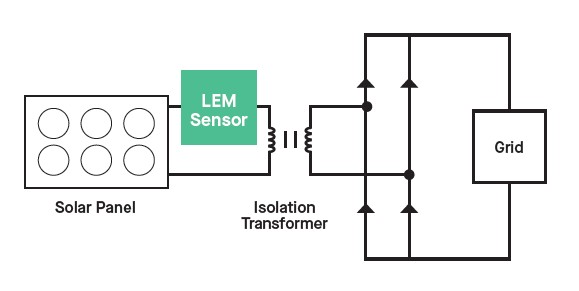
String inverter
String inverters connect to a series of solar panels (PV strings) and are typically installed in a central location. They are ideal for medium to large-scale solar installations and can deliver power to a single-phase or three-phase grid, with capacities ranging from a few kilowatts to hundreds of kilowatts.
Key features of string inverters include:
- High protection grade (often IP65)
- No need for a combiner box
- Wide input DC voltage range
- Advanced MPPT (Maximum Power Point Tracking) control
- High efficiency
- Flexible configurations for various applications
String inverters are cost-effective solutions commonly used in grid-tied solar PV systems, installed either indoors or outdoors, and can serve both residential and commercial applications.
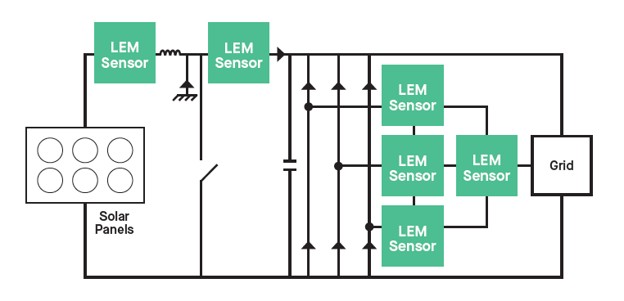
Centralized inverter
Centralized inverters convert DC electricity from multiple solar panels or wind turbines into AC electricity at a single power stage. They are typically used in large-scale systems, such as utility-scale solar farms or commercial rooftop installations, with capacities often exceeding 500kW per unit.
Centralized inverters are ideal for large power stations due to their ability to handle significant power outputs and deliver high efficiency.
Key features of centralized inverters include:
- Easy maintenance and energy management
- High power density with low costs
- Enhanced security for large installations
- Power factor adjustment and low voltage ride-through capability
Centralized inverters are commonly installed at central points within large solar farms or wind energy systems to streamline power conversion and transmission to the grid.
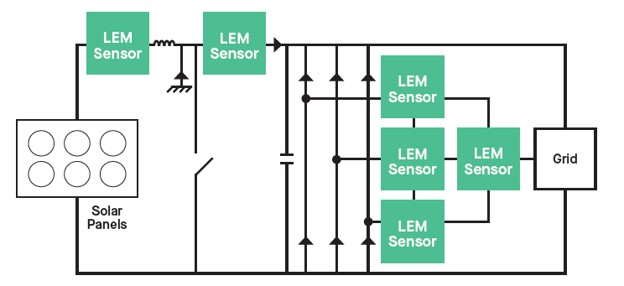
Wind Turbine Sensors for Onshore and Offshore Applications
Modern wind turbines, both onshore and offshore, convert the mechanical energy generated by rotating blades into electricity. LEM’s current sensors enhance the safety and efficiency of wind turbines in two key ways:
- Optimal Generator Performance: To maximize efficiency, electric motors rotate the nacelle and the rotor to align with the wind. Additionally, an active power control system adjusts the rotor blades along their longitudinal axis. LEM’s sensors, integrated into power converters, continuously measure the current to ensure precise positioning of the turbine for optimal performance.
- Safe Power Delivery to the Grid: The electricity generated must be fed into the power grid at a stable frequency and controlled voltage. LEM’s current sensors facilitate precise control and protection of the AC/DC (Alternating Current/Direct Current) converter, ensuring smooth and efficient power transmission to the grid.
Current Sensors solutions for Renewable Energy
| Bandwidth | 200kHz | 200Khz | 3.5kHz - 20kHz | 300kHz | 90kHz - 450kHz | 300kHz | 2kHz | 200kHz | 300kHz | 200kHz | 1000kHz |
| Current Range Max | 150A | 180A | 1.7A | 10A – 75A | 25A – 300A | 15A – 75A | 0.9A | 180A | 20A – 150A | 3400A | 9000A |
| Input Voltage | 5V | 5V | 5V | 3.3V – 5V | 3.3V – 5V | 3.3V – 5V | 5V | 5V | 5V | 12V – 24V | 12V - 24 V |
| Mounting | PCB | PCB | PCB | SOIC8 | PCB | SOIC10 | PCB | PCB | PCB | Panel | Busbar |
| Output | Voltage | Voltage | Voltage | Analog | Voltage | Analog, Digital | Voltage | Voltage | Voltage | Current | Voltage / Current |
| Overall Accuracy | 1% | 0.8% - 1% | 1.9% | 1.3% - 3% | 1% | 1% - 3% | 13.3% | 0.4% - 1% | 0.5% - 0.7% | 0.2% - 0.6% | 0.5% |
Certificates and standards
Compliance with the highest industry standards
LEM products and processes comply with reference standards in the industry:
- CE marking of LEM transducers in recognition of their electromagnetic compatibility
- IEC standards for solar applications :
- IEC 62109-1 for safety
- IEC 61800-1 & IEC 61800-2 for climatic and mechanical constraints
- IEC 61800-3 for EMC
- RoHS compliant
- ISO TS 16949 certification of all production and development centers (Switzerland and China)
Quality products and services: our priority
Based on our deep knowledge of applications and current measurement technologies, LEM develops both catalog and customized products which can be perfectly tailored to meet your needs in terms of performance, space requirement and cost.
PRODUCT DOCUMENTATION
Discover LEM's innovative technologies designed to enhance the efficiency and safety of solar and wind energy applications. Our solutions empower you to optimize performance, reliability, and sustainability in renewable energy systems.
For a detailed overview of our cutting-edge products and how they can support your solar and wind energy projects, download our comprehensive brochure:
Application Guide: Find the Right Sensor Faster
Explore a wide range of real-world applications and discover how current and voltage sensing technologies are integrated into modern system architectures.
The LEM Application Guide combines application block diagrams, sensing insights, and recommended products to help engineers and developers identify the right solution and accelerate their design process.
NEED SUPPORT ON YOUR PROJECT?
You have a project in line with that application and want to discuss it with LEM?
Click on the contact button below and our experts will help you find the best solutions for your needs.