New LEM Application Guide accelerates sensor selection
A practical guide to faster sensor selection
Selecting the right current sensor or a voltage sensor often starts with a simple question:
Where should the sensor be placed inside the application, and which technology is best suited to the task?
To help engineers answer that question faster, LEM has released its new Application Guide, a practical resource that connects real-world applications with recommended sensing solutions.
Designed for design engineers, power electronics specialists, system architects, and developers, the guide provides a structured overview of how current and voltage sensing technologies are implemented across a wide range of electrification and energy management applications.
Instead of searching through individual product datasheets, engineers can quickly identify suitable sensing solutions based on their application and system architecture.
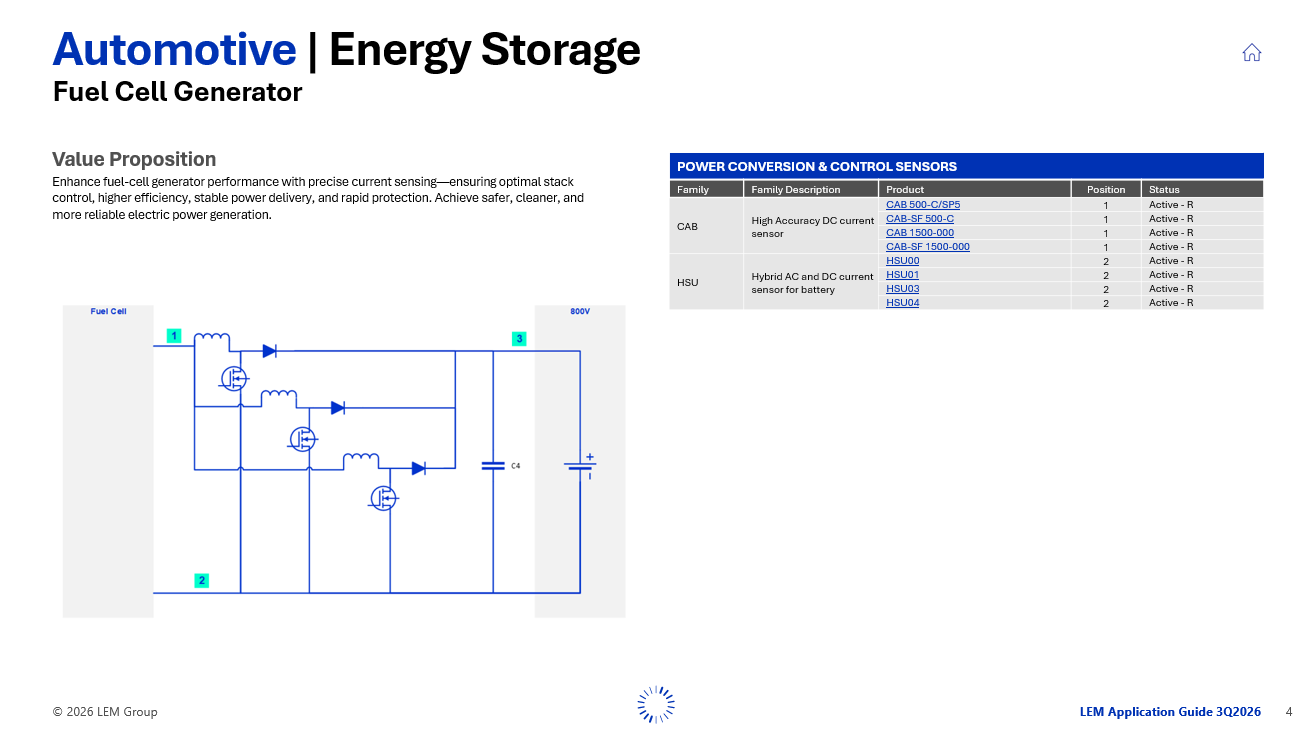
More than a product catalog
The LEM Application Guide goes beyond listing products.
For every application, engineers can find:
- A simplified application block diagram
- Typical sensor placement locations
- Key application challenges and requirements
- LEM's value proposition for the application
- Recommended sensor families and part numbers
This practical approach helps engineers understand not only which sensor to select, but also why a particular technology is recommended for a given function.
Whether the objective is current measurement, leakage detection, functional safety, efficiency optimization, energy metering, or motor control, the guide highlights suitable options within the LEM portfolio.
Built around real applications
The Application Guide brings together LEM's expertise across multiple industries and market segments, including:
Automotive | City & Infrastructure | Industrial | Home & Building | Rail Infrastructure |
|---|---|---|---|---|
|
|
|
|
|
Each application page is designed to provide immediate insight into how sensing technologies fit into the system architecture.
Download the LEM Application Guide

Whether you are designing an EV charger, industrial drive, battery system, renewable energy converter, UPS, or rail infrastructure equipment, the LEM Application Guide provides a fast and practical way to identify sensing solutions tailored to your application.