What is the difference between current sensors and voltage sensors?
In fact, there is no difference between a current sensor and a voltage sensor. They are both considered as current sensors.
The only difference is constructive and also comes from the number of primary turns.
In a current sensor, the primary coil will only come with a single turn, while the primary coil of a voltage sensor is made with a large number of turns (1000 turns in average). Plus, instead of measuring a wide current, we can, with a voltage transducer, measure a really low current in the range of 0.01 mA.
What Is a Voltage Transducer and How Does It Differ from a Sensor?
A voltage transducer is a device that converts an electrical voltage into a proportional output signal, typically used for monitoring, control, and protection in industrial and traction applications. While the term voltage sensor is often used interchangeably, there are subtle differences in usage and design.
- Voltage Sensor: Generally refers to any device that detects or measures voltage. It’s often used in broader, informational contexts and may include simple or passive components.
- Voltage Transducer: Specifically designed for high-performance applications, it provides galvanic isolation, signal conditioning, and standardized output (e.g., analog or digital), making it ideal for integration into control systems.
In essence, all voltage transducers are voltage sensors, but not all voltage sensors meet the rigorous standards and features of a transducer.
Measuring Voltage using Hall Effect, Fluxgate or Coreless Sensors
Voltage can be measured using current sensor to measure the small current flowing due to the voltage applied to a circuit with a large resistance. This current can be measured by an optimized Hall Effect voltage sensor or a Fluxgate sensor or an air-core sensor based on digital technology. In practice, the resistance is often split into two with the Hall Effect voltage sensor in the middle to improve common mode rejection.
Fluxgate technologies offer a higher accuracy, high performance voltage measuring with a larger bandwidth, while closed-loop Hall Effect and insulating digital sensors are cost-effective, general-purpose solutions to measuring voltage.
Featured LEM voltage sensors families
DVL
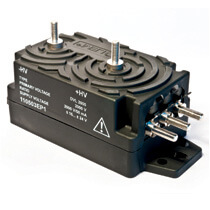
DVL, our best selling voltage transducer for traction and industrial applications
- Compact design
- A unique design to cover all measuring ranges
- Voltage measurement from 50 to 2000 VRMS
MAIN FEATURES
- DC, AC and pulse voltage measurements with galvanic isolation
- Power supply: +/- 13,5 ...26,4 V
- Operating temperature range: -40°C to +85°C
- Flexibility with modular connections for primary and secondary sides (connectors, shielded cables, terminals ...)
DV
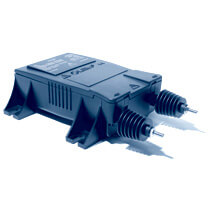
DV is our voltage sensor for traction applications with excellent accuracy and a delay time of 60µs
- Compact design
- A unique design to cover all measuring ranges
- Voltage measurement from 1200 to 4200 VRMS
MAIN FEATURES
- DC measurements with galvanic isolation
- Power supply: +- 13,5 ...26,4 V
- Operating temperature range: -40°C to +85°C
- Flexibility with modular connections for primary and secondary sides (connectors, shielded cables, terminals ...)
DVM
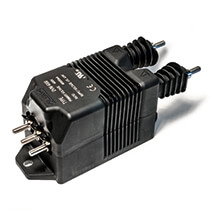
DVM voltage transducer family can be used in industrial and traction applications, on-board trains but also for trackside
- Compact design (30% smaller, 25% less volume)
- A unique design to cover all measuring voltage ranges 600 to 4200 VRMS
- High level of insulation test voltage: 12 KVRMS / 50 Hz / 1 min
MAIN FEATURES
- Power supply: +/- 10.8 ...26.4 V
- Operating temperature range: -40°C to +85°C
- Flexibility with modular connections for secondary sides (connectors, Inlets, terminals ...)
Which parameters need to be considered to select the right voltage sensor?
The selection criteria for a voltage transducer are the same as the ones for a current sensor. Here again, the entire application needs to be considered to pick the appropriate voltage sensor.
Just like for current sensors, the following parameters need to be considered when choosing your voltage transducer:
- Electrical requirements: power supply, peak measurement, response time…
- Mechanical requirements: aperture size, overall dimensions, mounting, materials…
- Thermal conditions: current profile versus time, maximum RMS measurement, cooling…
- Environmental conditions: vibrations, temperature, proximity of magnetic fields…
The main difference come from the primary parameters which affect the link between the voltage to be measured and the current, IMES’ detected by the sensor, namely the effect of the series resistance R1 and the parameters linked to the sensor primary impedance.
This leads to the following additional selection criteria for voltage sensing:
Electrical parameters
- Measurement accuracy
- Power budget
Dynamic operating parameters
- Bandwidth / response time
Where do we find voltage sensors?
Voltage sensors are used in every area where voltage needs to be measured. It concerns:
- Power supplies
- Industrial applications: welding, drives
- High precision
- Renewable energies
- Traction
Why Choose LEM Voltage Transducers?
LEM is a global leader in electrical measurement solutions, trusted by OEMs and system integrators worldwide. Our voltage transducers are engineered for performance, safety, and reliability.
- Wide Product Range: From compact PCB-mounted transducers to high-voltage industrial models.
- Application Expertise: Proven solutions for traction, renewable energy, and industrial automation.
- Innovation & Quality: Swiss-engineered products with global support.
- Compliance & Certification: Designed to meet international standards (e.g., IEC, UL).
Whether you're designing a new system or upgrading an existing one, LEM voltage transducers deliver the precision and durability you need.
Where to Buy Voltage Transducers?
Looking to purchase LEM voltage transducers? Use our Check Stock Tool to view real-time availability from our trusted distributor partners.
This tool helps you find the right product quickly and ensures fast delivery through our global distribution network.
Want to know more about our voltage sensing offer?
If you want to know more about the technologies used in our voltage transducers ranges, feel free to visit our innovation and technology area.
To find a voltage sensor for your application, you can also use the LEM voltage sensor selector tool and its smart filters.
Our team remains available for any inquiry you might still have.