The Data Center Power Revolution: Challenges & Evolving Architectures
A Market Entering a New Era of Scale and Complexity
The rapid rise of Artificial Intelligence is driving a structural transformation in the data center market. Global data center capacity is expected to reach 220 GW by 2030 (from 80 GW in 2025), largely fuelled by AI workloads, which are projected to increase 3.5x over the next five years1. This transformation is visible in both the size and energy footprint of modern facilities. Data centers are growing to tens of megawatts on average, with hyperscale campuses moving toward gigawatt-scale deployments traditionally associated with heavy industry.
AI is the key driver behind this shift, with a sharp increase in computing power density. AI chips have seen rapid growth in power consumption (from 200W in 2017 to about 1,400W in 2025). As a result, data center rack density is scaling exponentially, from 8.5 kW per rack in 2020, to 25 kW in 2022 to an expected 1 MW by 20282. This dramatic increase (x10 in less than a decade) presents major challenges for power delivery, efficiency, and thermal management.
1 McKinsey, 2025: A $7 trillion race to scale data centers
2 Datacenters.com, 2026: AI Workloads Are Increasing Data Center Rack Density by 5x
From AC to DC: The Transformation of Data Center Power Architectures
One of the most significant transformations in modern data centers is the evolution of power distribution architectures, moving from traditional low voltage AC-based systems toward high-voltage DC distribution.
Conventional data centers have historically relied on low voltage AC distribution, with multiple conversion stages from the grid down to the server level. AC distribution is done at standard 480 VAC and 280 VAC, with conversion from AC to 12 VDC occurring inside each server. AC architecture boasts a well-established supply chain, but it introduces cumulative losses at each power conversion step, and more importantly, limits the amount of power distributed to the IT racks. AC distribution reaches its physical limits demand increases beyond 170 kW per rack3, these inefficiencies become more significant, directly impacting both operational cost and thermal management.
To address these limitations, the industry is shifting towards DC distribution architectures. 800V DC enables higher efficiency and reduced conversion losses, making it better suited for ultra-high-density environments. By increasing the distribution voltage, these architectures significantly reduce current for the same power level, enabling thinner cabling, lower resistive losses (I²R), and higher overall power density. In parallel, reducing the number of conversion stages can further improve end-to-end efficiency.
The path towards DC distribution will not be linear. A first intermediate stage will see partial DC architectures, introducing 800 VDC distribution through a “Sidecar” concept. The sidecar centralizes the power supply units (PSUs) in a separate power rack and provides a 800V DC busbar output that serves one or more IT racks, allowing to increase the delivery up to IT racks of 400 kW power density. This model retains the AC infrastructure elements up to the IT room (distribution transformer and AC switchgear, centralized UPS, AC PDU), allowing the industry supply chain some time to prepare for the upcoming full DC architecture. Furthermore, as time-to-market is key, this sidecar option shortens qualification and commissioning time.
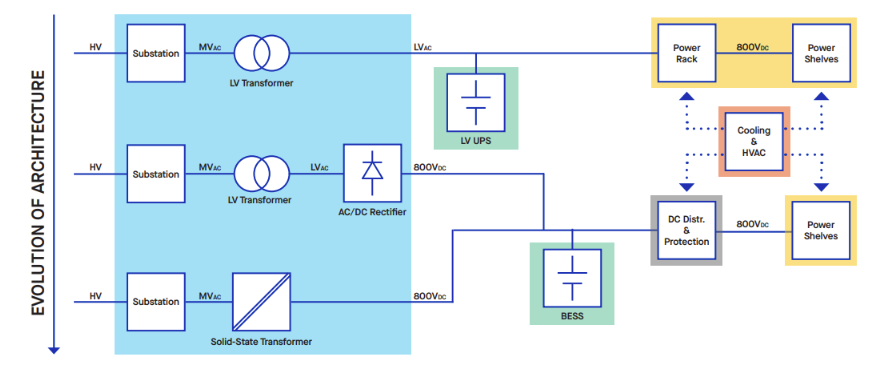
Evolution of datacenters architecture, from AC to full DC
The endgame, however, is a full DC architecture, where power conversion is fully centralized outside the IT room, further reducing power losses. Solid state transformers will become central components, performing voltage conversion, AC/DC conversion, protection, power quality management, and integration of batteries into a unified 800VDC output. Distribution of power is done at 800V DC with large busways. Solid state circuit breakers and DC leakage monitoring will play a key role in providing different levels of protection in full DC architectures. Innovative power electronic solutions using wide bandgap semiconductors (SiC and GaN) are being developed to convert the incoming 800 VDC to 12VDC to the GPU, saving critical space and minimizing power losses.
However, moving toward high voltage DC architectures also introduces new technical challenges, including protection, stability, and control of DC networks. These evolving requirements are driving innovation across the entire power chain, from conversion technologies to monitoring and control systems. As data centers continue to scale, the ability to efficiently manage these new architectures will become a key differentiator in delivering high-performance, energy-efficient infrastructure.
1 Schneider Electric, 2026: 5 Principles for 800 VDC in AI Data Centers
The challenging load profile of AI datacenters
Unlike traditional datacenters, AI-specific data centers rely on thousands of GPUs operating in tightly synchronized clusters, making high-speed communication as critical as raw compute power.
Since 2005, computing performance has increased by nearly 90,000 times, while data transfer speeds have improved by only about 30 times. As a result, GPUs frequently alternate between periods of intensive computation and data exchange. When data cannot be moved fast enough, processing resources sit idle waiting for information, creating rapid and significant load fluctuations.
In practice, rack power demand can swing from 30% to 100% utilization within milliseconds. To put in context, a non-AI workload traditionally experiences 1.5 MW of load during peaks, while a AI workload sees a 15 MW peak in milliseconds.
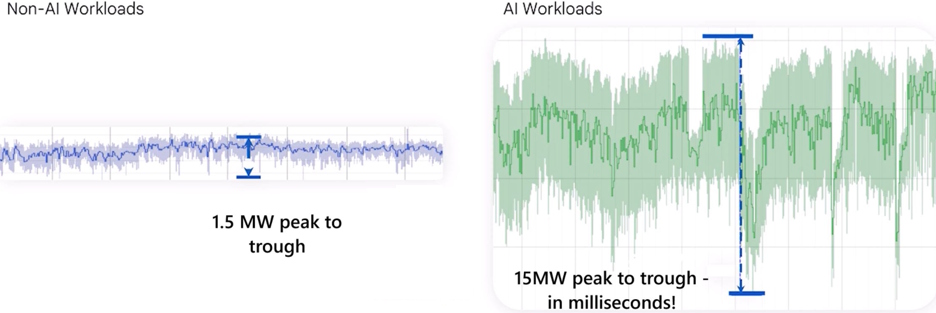
Non-AI vs AI workloads (source: Google at OCP EMEA Summit 2025)
To prevent these highly dynamic workloads from destabilizing the utility supply, energy storage is deployed as a local power buffer that decouples GPU demand from grid constraints. Short-duration storage, typically rack-level Battery Backup Units (BBUs), absorbs millisecond-scale power spikes and fills brief power valleys, ensuring a stable supply to the IT equipment. Complementing this, larger battery systems such as UPSs or centralized BESS installations provide longer-duration support, delivering ride-through capability during utility disturbances and backup generator transitions. Together, these storage layers smooth power fluctuations, enhance resiliency, and enable the grid to support increasingly dense AI workloads without being exposed to their rapid transient behavior.
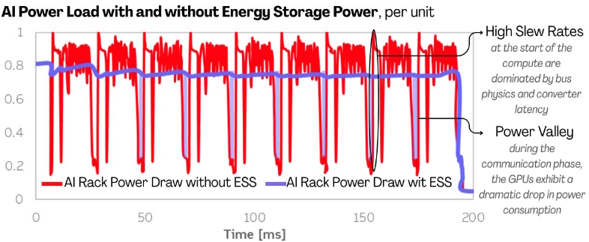
Source: Choukse, E., et. al., “Power stabilization for AI training datacenters”
Why Current Measurement Becomes Mission-Critical
As power levels rise, so does the need for accurate, insulated and reliable current sensing across both power conversion and power distribution applications. This drives a strong increase in the number of sensors deployed across data center applications. Looking ahead, the transition toward more integrated and DC-oriented architectures will further increase the importance of current sensing. As a result, the current sensor market in data centers is expected to grow around 18% annually throughout 2030.
In today’s architectures, current measurement is already critical across multiple subsystems, including power distribution, power conversion stages, battery backup units, and auxiliary services like HVAC (chillers, pumps, and fans still run on AC motors, requiring DC-to-AC inverters). As data centers evolve into high-density, dynamic electrical environments, current measurement becomes a fundamental enabler of efficiency, reliability, and control.
First, it impacts energy efficiency by enabling real-time visibility into losses across multiple conversion stages, an increasingly critical factor as architectures move toward higher voltages and DC distribution.
Second, it ensures system protection and safety, allowing fast detection of overloads, faults, and leakage currents in both AC and DC environments where resilience requirements are extremely high.
Lastly, it also plays a key role in managing dynamic AI workloads, where fast transient responses are required to maintain voltage stability and system performance at the rack and chip levels. In parallel, it enables advanced monitoring and DCIM integration, providing the granular data needed to optimize energy usage and infrastructure reliability at scale.
AI data centers are pushing power systems to their limits, creating a power density challenge that requires more efficient and compact current-sensing solutions. Three key obstacles must be addressed:
- Bandwidth: High-speed GaN and SiC power devices require current sensors with very high bandwidth to accurately detect fast transients and protect systems from overcurrent events.
- Thermal Management: Traditional shunt-based sensing generates heat and measurement drift, reducing efficiency and forcing designers to add larger safety margins.
- Noise Immunity: Dense server environments produce significant EMI and high dV/dt transients that can interfere with current measurements, requiring sensors that maintain accuracy without bulky filtering or shielding.
To enable higher power density and efficiency, next-generation current sensors must provide high bandwidth, low loss, strong noise rejection, and galvanic isolation, ensuring safe and reliable operation of AI data center power supplies.
1 LEM internal estimate