Sigma-Delta Digital Output Current Sensors for Industrial Applications
Digital output current sensors for precise servo drive control
Current sensors are central to factory automation. They provide the current feedback required for precise motor control, help protect equipment and operators, and support efficient operation. In servo drives and inverter-driven systems, accurate current measurement contributes directly to torque and speed regulation, while rapid overcurrent and short-circuit detection helps prevent damage.
As industrial motion systems demand greater precision, reliability and integration, sensors with Sigma-Delta (ΣΔ) digital output offer an alternative to a conventional analog signal chain. Their bitstream output supports strong noise immunity, a simplified connection to digital controllers and flexible filtering on the user side.
Why Sigma-Delta Current Sensing Matters in Digital Motion Control
Precise current feedback for accurate motion
Servo motors and robotic axes depend on accurate current feedback to regulate torque, position and speed. A Sigma-Delta current sensor provides a high-resolution, low-noise digital output that can support smooth motion and precise positioning.
Galvanic isolation in high-voltage environments
Servo systems and industrial robots operate alongside high voltages and fast-switching power electronics. Built-in galvanic isolation separates the measurement side from the control electronics, supporting system safety and robustness against electrical disturbances.
Digital transmission in electrically noisy systems
Instead of transmitting an analog voltage, a Sigma-Delta sensor outputs a digital bitstream. This signal is less susceptible to electromagnetic interference and can support reliable transmission over longer distances in demanding industrial environments.
A simpler interface to microcontrollers and DSPs
The bitstream can be decoded by a microcontroller or digital signal processor using a digital filter, such as a sinc filter. Moving this filtering and conversion function into the controller reduces the need for a complex analog signal chain and allows the output format to be adapted to the system architecture.
Synchronized feedback for multi-axis systems
Multi-axis robots and machine tools require current measurements to be aligned across several drives. Sigma-Delta sensors can share a common clock, helping synchronize measurements between axes. The digital interface can also reduce the need for costly analog input channels.
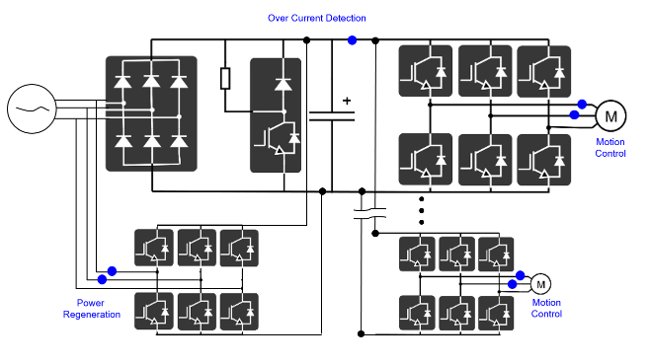
Figure 1. Typical multi-axis servo-drive topology and representative current-sensing locations.
The same principle applies across different motion architectures. A six-axis robot uses six servo motors, while a machine tool may combine three positioning axes with a spindle servo drive. In both cases, current feedback is required around the inverter stages that control each motor.
From Primary Current to Sigma-Delta Bitstream
Adding a Sigma-Delta modulator to an accurate, compact current transducer changes where the analog-to-digital conversion is completed. The sensor produces a one-bit stream, while the user selects and implements the digital filter. This provides a direct way to balance resolution and response time according to the application.
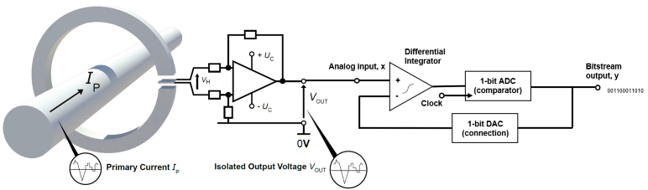
Figure 2. Open-loop current sensor architecture with an isolated output and Sigma-Delta modulation.
LEM has integrated a second-order Sigma-Delta modulator into an improved ASIC for a new family of transducers. In the resulting output stream, the density of logical ones varies with the measured primary current.
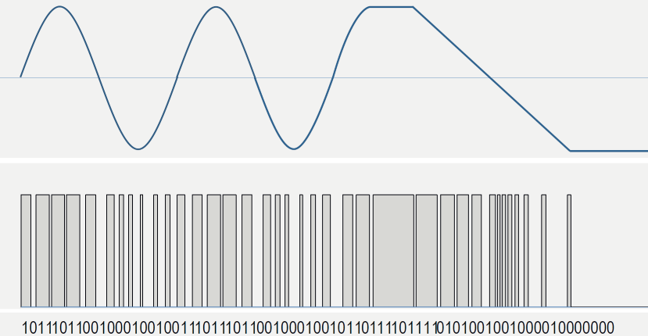
Figure 3. Illustration of a measured waveform converted into a Sigma-Delta bitstream.
The transfer function can be expressed as an average density of ones from 0 to 1. After filtering, the same measurement may be represented as a 16-bit word from 0 to 65,535. Over the specified measurement range from −IPM to +IPM, the digital output spans an average density from 0.1 to 0.9. The equivalent analog transducer output spans from 0.1 to 0.9 of its supply voltage.
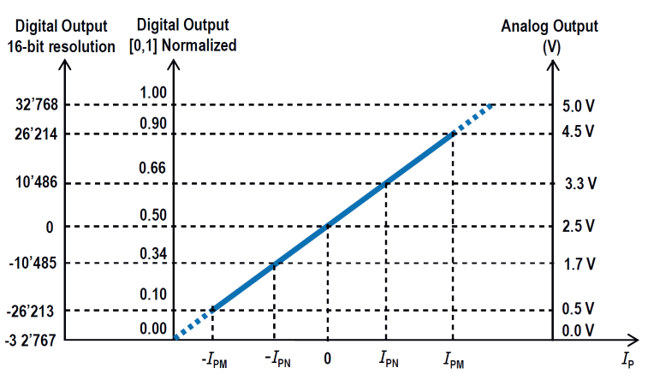
Figure 4. Relationship between primary current, normalized digital output, 16-bit representation and analog output.
User-Defined Filtering: Balancing Resolution and Response Time
The digital filter is implemented on the user side. This minimizes the number of sensor connections and lets the designer choose the filter architecture and output format that best matches the control system.
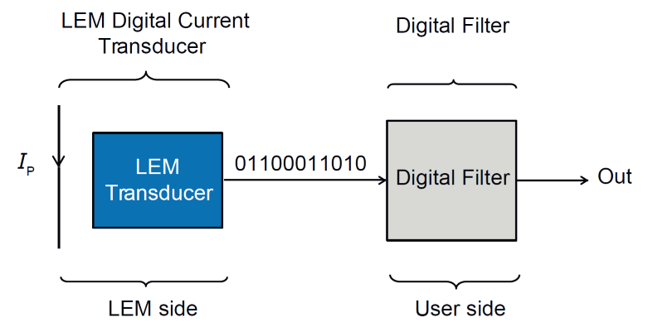
Figure 5. Division of functions between the LEM digital current transducer and the user-side digital filter.
As with any filter, order and bandwidth determine the measurement trade-off. A narrow bandwidth lowers noise and increases effective resolution, but it also increases response time. A wider bandwidth provides a faster response with lower resolution.
One bitstream can be processed through separate filters for different functions. In the example below, a 20 kHz filter provides 12-bit resolution for accurate current measurement. A second, wider-band filter detects an out-of-range current in approximately 5 μs. In parallel, the sensor’s internal overcurrent-detection output identifies a short circuit in 2.7 μs.
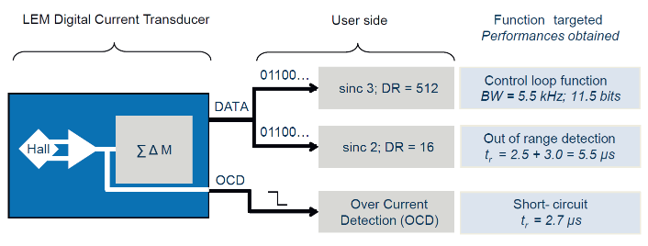
Figure 6. Example of filter order and decimation ratio selected for control-loop measurement, out-of-range detection and short-circuit protection.
LEM Digital Output Current Sensor Portfolio
LEM offers integrated and open-loop current sensors with Sigma-Delta bitstream outputs for servo-drive and robotics applications. The portfolio covers different mounting formats, current ranges and interface options.
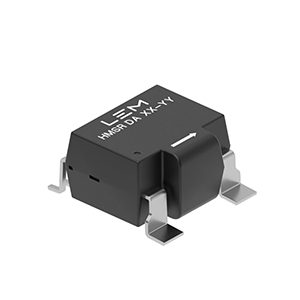 | HMSR-DAAn integrated current sensor with a one-bit Sigma-Delta output, developed for low-noise current sensing.
|
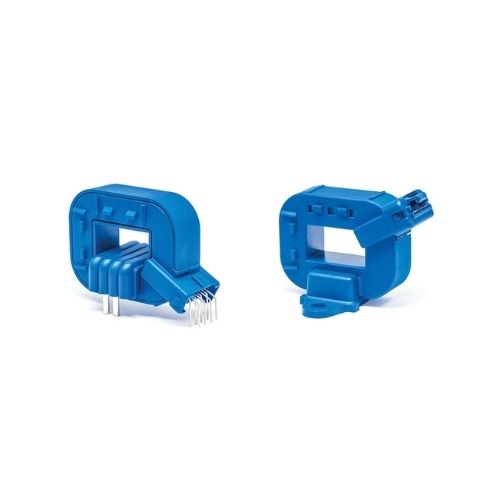 | HO DigitalOpen-loop Hall-effect current sensors with a Sigma-Delta modulated output for higher-current applications, available in PCB- and panel-mounted formats.
|
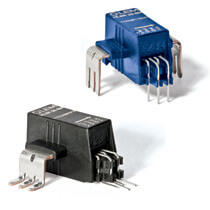 | HLSR DigitalCompact PCB-mounted current sensors for medium-current applications with a Sigma-Delta output.
|
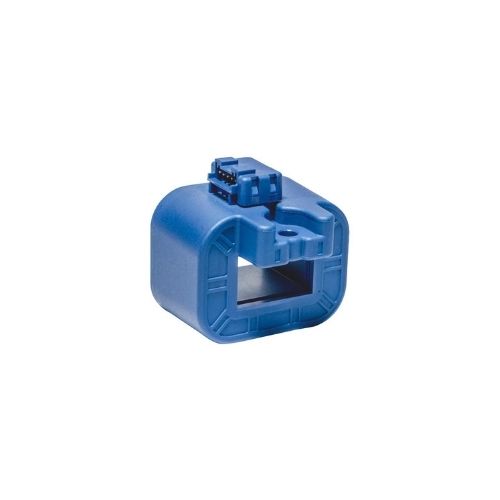 | HOYS DigitalPanel-mounted, open-loop Hall-effect current sensors with Sigma-Delta modulated output for high-current applications.
|
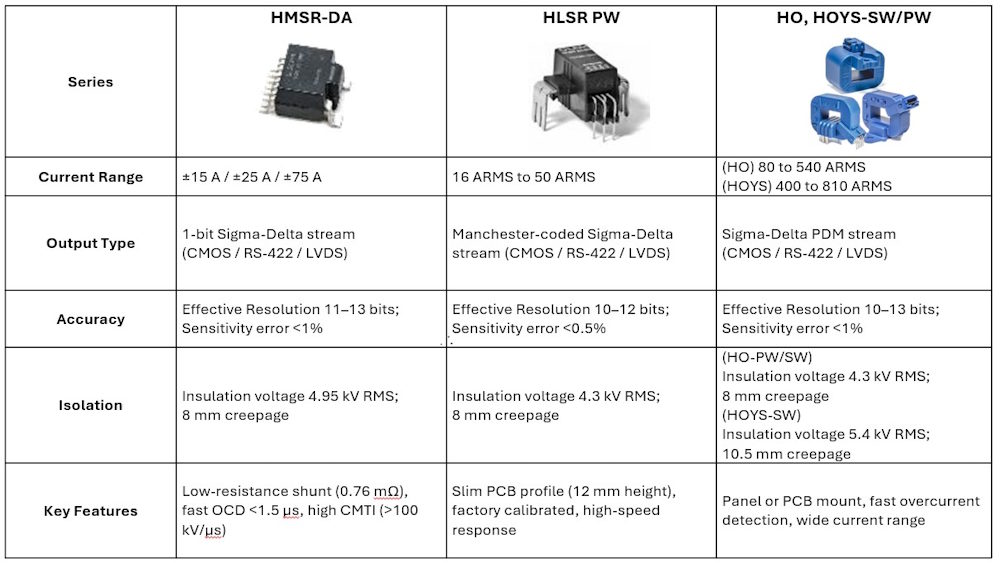
Figure 7. Summary of LEM digital output current sensors for servo-drive applications.
Industrial Applications of Sigma-Delta Current Sensors
Machine tools
Servo control in machine tools enables high-precision, high-speed tracking of commanded position, speed and torque. For the spindle motor of a machining center, the higher-current HO-PW/SW and HOYS-SW products can be used. HLSR-PW and HMSR-DA products are recommended for the positioning servo motors on the X, Y and Z axes.
Industrial multi-axis robots
An industrial robot coordinates several joints, typically across six axes, to move its end effector to a target position and orientation. Synchronous control aligns the axes to generate complex trajectories, while control algorithms and filtering can suppress small vibrations associated with limited arm rigidity. HLSR-PW and HMSR-DA current sensors can be used in the servo-drive control loops that support these functions.
Outlook: Toward More Integrated Digital Current Sensing
Digital-output current sensing is still at an early stage of adoption, but it represents a clear direction for future industrial motion-control systems. Wider deployment will provide additional application feedback and help validate digital-output architectures across a broader range of use cases.
Further developments can combine LEM’s integrated current-sensor design expertise with next-generation sensing technologies such as tunnelling magnetoresistance (TMR), faster clock speeds, higher effective resolution and lower temperature drift. Compared with Hall sensing, the draft identifies higher sensitivity and lower noise as potential TMR advantages. These characteristics could support improved low-current accuracy, native resolution, miniaturization and system-level integration.